

There is something I have been noticing lately.
I can spend twenty minutes watching someone prepare a beautiful meal and genuinely imagine myself making it. A few days later, I’m standing in my own kitchen preparing something familiar. The excitement I felt while watching was real. It simply remained on the screen.
That small experience seems almost too ordinary to think about. Yet once I began noticing it, I started seeing versions of it everywhere.
We watch people restore furniture, cross distant landscapes, master difficult skills, transform neglected gardens, discuss books, learn languages and build things with their hands. We save articles we intend to read and recipes we intend to make. For a brief moment, the experience feels surprisingly close, as though some small part of it has already become ours.
Perhaps what we acquire is the feeling of proximity.
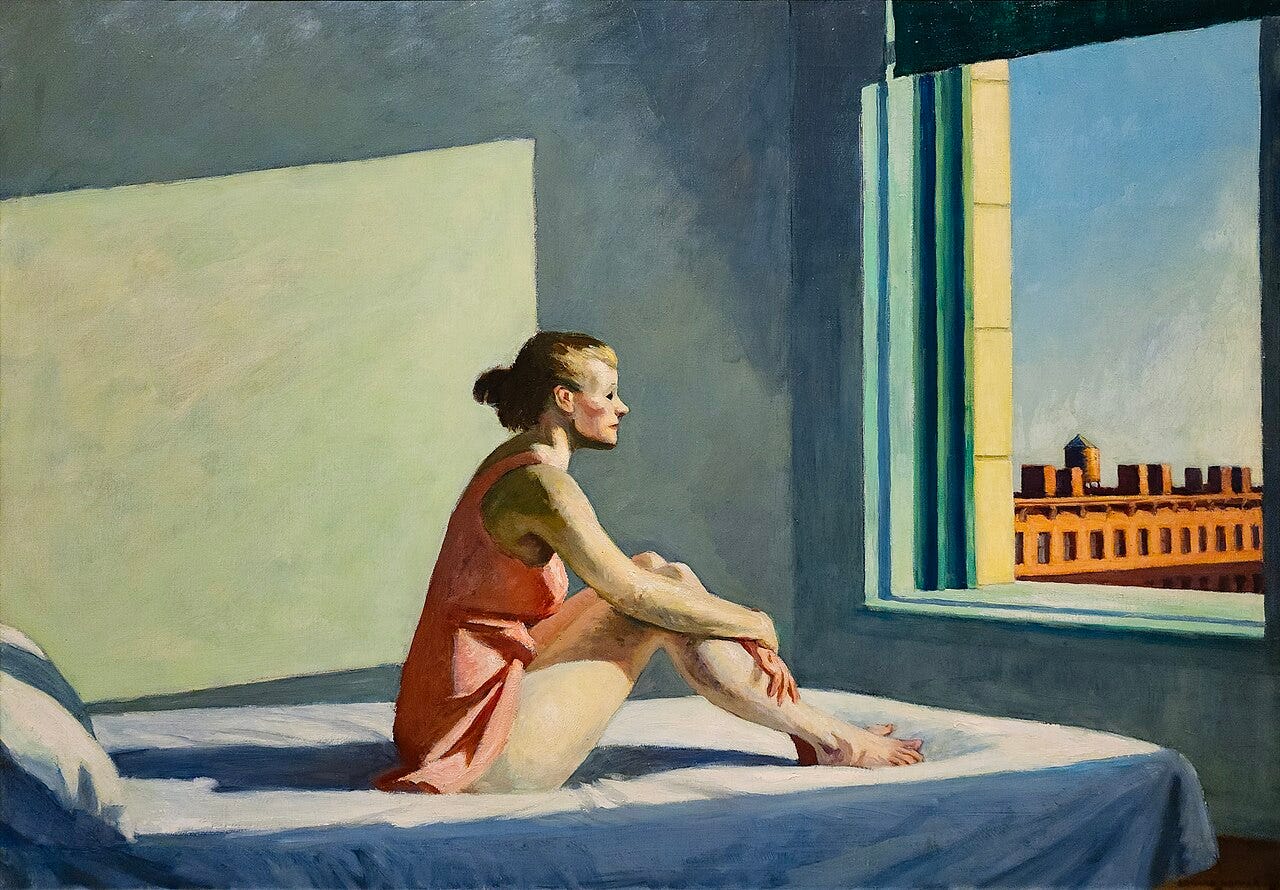
I think of Edward Hopper’s Morning Sun, a painting that has stayed with me for years. A woman sits upright on a bed, fully dressed and awake, looking through a large window toward a city we cannot see. Sunlight has already crossed the distance and reached her. She seems neither withdrawn from the world nor quite engaged with it. Hopper leaves her in that unresolved space, close enough to observe, with whatever comes next still entirely her own.
That may be part of what draws me to the painting. There is a difference between having the world before us and entering it.
We have extraordinary access to other people’s knowledge, creativity, adventures and ideas. A question that once required hours of searching can be answered in seconds. We can learn from people we will never meet and see places we may never visit. There is much about this world I wouldn’t willingly give up.
Still, one question keeps following me: when does witnessing something begin to feel like enough?
I started noticing the question away from the screen too. A walk through the neighborhood. A conversation with a friend. A morning spent writing. Even cooking dinner. So many experiences ask something of us before they offer anything in return.
Cooking takes time. Friendship needs attention. Learning requires patience. Writing can mean sitting for quite a while with something that refuses to become clear. Even walking changes when we pay attention to where we are.
The experience is shaped partly by what it requires of us.
Watching someone hike through the Alps may inspire us. Walking the trail ourselves gives us tired legs, unexpected weather, wrong turns, conversations we couldn’t have planned and memories belonging to no one else.
A summary of a novel can tell us what happens. Reading it means spending time with another mind, becoming impatient with it, questioning it, perhaps even becoming bored before discovering something we hadn’t expected.
Written down, the distinction seems almost embarrassingly obvious.
Living it is another matter.
The bargain of convenience
Convenience has improved daily life in ways I wouldn’t willingly surrender. I don’t miss unfolding paper maps on unfamiliar streets. I don’t miss standing in line to pay bills. I certainly don’t miss waiting several days for photographs to be developed only to discover that half of them didn’t turn out.
We have removed enormous amounts of unnecessary friction from ordinary life. Now we can also hand over tasks that once required considerable time and effort. Artificial intelligence takes this much further, helping us research, organize, write, analyze, plan and solve problems with astonishing speed.
I use these tools. I value them. Increasingly, though, I find myself wondering about the abilities that get less exercise as a result.
Resourcefulness is one of them.
When I was preparing my master’s thesis, research required movement. I went to libraries, searched for material, figured out who knew something about the subject and found ways to reach them. Some leads were useful. Others led nowhere. One source pointed toward another. Finding the information was part of the research.
I don’t remember thinking of myself as resourceful. It was simply what the work required.
There was something else happening in the process, though. When what I needed wasn’t available, I had to decide where to look next. A dead end meant trying another direction. Sometimes the resource I needed didn’t seem to exist.
That habit followed me into my career and, eventually, much of my life: find the resource, create the resource, or become the resource.
Many obstacles that once demanded this kind of searching have since disappeared. Good riddance to plenty of them. Spending three days finding information that can now be located accurately in three minutes gives those lost days no special nobility.
I am more interested in what happens to the capacities we no longer need to call upon so often.
Resourcefulness may be something closer to a practice than a possession. And eventually it leaves the library.
We need it when work changes unexpectedly, when a friendship becomes difficult, when we arrive somewhere unfamiliar, when someone we love needs something we don’t immediately know how to give, or when a plan we trusted stops working.
Life offers remarkably few instructions in those moments. We try something. We read the room badly. We try again. We ask someone. We wait when we would rather have an answer. Sometimes we discover that the way through bears little resemblance to the one we had imagined.
Over time, those experiences become part of how we learn to respond.
As daily life asks for less of that exercise, I wonder whether we will remember to seek it elsewhere.
Delegation has its own intelligence. Knowing what deserves our attention and what doesn’t can be an expression of judgment rather than avoidance. What I want to preserve is the instinct to engage before deciding what can reasonably be handed elsewhere.
I keep coming back to the first question we ask when something difficult appears.
How might I find my way through this?
Remembering before
I belong to a generation with a peculiar reference point: I remember both worlds.
I remember researching without search engines and finding my way without GPS. I remember when “going online” described an actual activity. You went online, did whatever you needed to do, and eventually went offline again.
That boundary gradually disappeared.
For someone who grew up later, there may be little reason to think of the internet as a separate place at all. It is woven into communication, education, work, entertainment, relationships and the mundane logistics of getting through a day. Younger generations participate every bit as genuinely in their lives. They simply began somewhere else.
Artificial intelligence may be establishing the next starting point.
Generation Z grew up with the internet, yet most of its members can remember learning, researching, writing and creating before generative AI became readily available. Children growing up now may eventually have no such memory.
This is where I find myself lingering.
How do we recognize something as optional when we have never experienced it as necessary?
Someone who has always navigated with GPS doesn’t experience the disappearance of paper maps. GPS is simply how one gets somewhere. In time, asking AI to explain an idea, begin a piece of writing or organize a project may feel equally unremarkable.
There is no before against which to measure the after.
Those of us who remember both occupy a temporary vantage point. We can still feel the moment when something we once did ourselves becomes something we allow a tool to do for us. Often, handing it over is exactly the sensible choice. The memory simply makes the choice visible.
Eventually, that memory will fade.
Then participation will have to stand on its own merits.
I find that possibility far more interesting than nostalgia. Every generation inherits conveniences the previous one lived without. Few of us would surrender indoor plumbing to preserve the resourcefulness required to carry water.
What deserves more thought are the human capacities that remain valuable long after technology makes exercising them unnecessary.
Future generations will undoubtedly develop forms of resourcefulness I cannot imagine. Every generation does. Yet some experiences may continue to deserve our direct involvement because of what happens to us while we are having them.
The decision that remained mine
Around the time I was thinking about all of this, the question appeared in my own life.
I was deciding how much traveling I wanted to do this year. I had planned a trip to Nice and was considering London as well. For a while, I went back and forth over whether doing both was sensible.
Money was the obvious concern.
I thought about work and its uncertainty, the markets, retirement, the future, and all the responsible questions we learn to ask before spending money on something we don’t strictly need. They deserved consideration, and I gave them plenty.
Yet I kept circling the decision.
Eventually I understood why.
I was asking myself whether I trusted the man who had earned this life.
The thought landed harder than I expected.
Nothing around me had changed. The future remained unknowable. Work hadn’t become more secure. The markets certainly hadn’t made me a promise. What changed was where I placed my trust.
I had spent years finding resources when I needed them, creating them when they weren’t there, changing direction when something stopped working and gradually building a life that gave me choices. Yet here I was, facing one of those choices while giving uncertainty more authority than my own history.
I booked both trips.
What stayed with me afterward had surprisingly little to do with travel. Circumstances can inform a life without assuming authorship of it.
Markets move. Work changes. Technology develops. Plans fail. People surprise us. Circumstances have always had a vote in our lives.
They don’t need every vote.
I return often now to the idea of trusting the man who earned this life. Over time, the phrase has taken on a different meaning. It carries less entitlement than responsibility. Trusting the person I’ve become means trusting him to decide, to act, to adjust and to meet whatever follows.
Perhaps that is where participation eventually leads.
We learn that we can find our way because we have watched ourselves do it before.
What remains ours
More and more of life can be observed, assisted, predicted, summarized, automated or delegated. We have gained time, access and possibilities previous generations could scarcely imagine. What we do with that freedom remains ours.
Some experiences still acquire their meaning through our presence in them. A conversation that requires courage. A page that refuses to come easily. A place discovered by walking without knowing exactly what waits around the corner. A problem with no obvious resource. A decision whose uncertainty cannot be calculated away.
Participation may increasingly become something we choose rather than something life requires of us.
The world will continue changing without asking whether we are ready. New tools will remove difficulties we once considered unavoidable. Generations will grow up without remembering the friction that preceded them, and they will discover ways of participating that those of us looking backward cannot yet imagine.
Human beings have always found ways to enter their own lives. The invitation may simply become easier to decline.
So I am left with a question rather than an answer: when life no longer requires our participation, where will we still choose to give it?
I suspect my own answer will continue appearing in ordinary places: something I choose to learn for myself, a difficult question I stay with a little longer, a journey I choose to take.
There is still a life that can only be lived by us.